Saturday, November 24, 2012

Individuals are Bad Representatives of Political Parties

A lot of discussion has erupted after the Republican Party's miraculous ability to snatch defeat from the jaws of victory for a second set of elections. While the Senate was easily winnable in 2010, a set of Tea Party fanatics threw away shoe-in races. While no President should be electable with employment over 8 percent during much of the campaign, extreme positions adopted by Mitt Romney to apease the base had the same effect.

Clearly, something needs to change. Andrew Bacevich, a Professor of International Relations and History at Boston University, has some suggestions.
First, conservatives should claim the environmental movement as their own. Preserving the natural world should be a cause that all conservatives embrace with gusto. And, yes, that includes the issue of climate change.

Second, conservatives should lead the way in protecting the family from the hostile assault mounted by modernity. The principal threat to the family is not gay marriage. The principal threats are illegitimacy, divorce, and absent fathers. Making matters worse still is a consumer culture that destroys intimate relationships, persuading children that acquiring stuff holds the key to happiness and persuading parents that their job is to give children what the market has persuaded them to want.

Third, when it comes to economics, conservatives should lead the fight against the grotesque inequality that has become such a hallmark of present-day America.

Call me old fashioned, but I believe that having a parent at home holds one of the keys to nurturing young children and creating strong families. That becomes exceedingly difficult in an economy where both parents must work just to make ends meet.

Flattening the distribution of wealth and ensuring the widest possible the ownership of property can give more parents the choice of raising their own youngsters rather than farming the kids out to care providers. If you hear hints of the old Catholic notion of distributism there, you are correct.

Finally, when it comes to foreign and national security policies, conservatives should be in the forefront of those who advocate realism and modesty. Conservatives should abhor the claims of American dominion that have become such a staple of our politics. Saving humanity is God’s business, not America’s.

Sure, we need a strong military. But its purpose should be to defend the country, not to run the world. And anytime Washington decides it needs to fight a war, then popular support should going beyond cheering. That means higher taxes to pay for the war and an army drawn from all parts of American society – to include Domers – to fight it.
I don’t seriously expect the Republican Party to show the least interest in any such ideas. But that’s because the actually-existing Republican Party is anything but conservative.
Obviously, there is little reason to believe that the Republican Party is going to embrace these concepts with open arms. Change is hard, after all. But I think these comments lead to a much larger conclusion. 

We all wear several hats in life - brother, friend, lover, mustache aficionado - but few places make this distinction more obviously than American electoral politics. We're all affiliated to "teams," and yet we're all individuals at the same time. What's more, we're supposed to be voting for members of a distinct political party while assessing them based on their own particular quirks at the same time. 

You see this all the time in our debates. As an Obama nut-hugger, I'm always thrown into the position of defending activist foreign policy that I mostly disagree with. Ron Paul fans have to defend a predatory form a lassiez faire that they don't really believe, since this is associated with the Koch Brothers kind of Libertarianism. And moderate Republicans are immediately thrown to the wolves whenever we need to rant about that obscure monster called "conservatives."

I don't think any of us should take these things personally. In the realm of politics, by becoming affiliated with any particular body, we inevitably stand for more than what we find important, or even believe. It's important to remember than within the major tents, many different views can flourish. The history of conservationism, which dates back all the way to Teddy Roosevelt, is an important part of the history of the American right. We wouldn't have things like our National Park System, the Forest Service or the Sierra Club if it wasn't for environmentally-minded Republicans. It's a little silly that this fact is now completely ignored in our mainstream political debate.

But it's also important to assess the current state of the tents. It's not unfair to say that the current Republican Party, as represented by its platform, deviates in important ways from some of the common-sense beliefs of its members and of the society at large. The focus of the party is narrowing to match its base, becoming more preoccupied with the very limiting concerns of older white men. As The National Review puts it, the activist and donor base is fully in charge, and these people have very little in common with the rest of America. The same problem consumed the Democratic party in the middle of the 80s, leading it to some of the most embarrassing defeats in modern politics.

It's not unfair to say that the Republican party, as it closely follows the interests of several corporate donors, is hostile to the environment. It's not unfair that they're policies are hostile towards women, even though few Republicans are not genuinely misogynistic. It's not unfair to say that the party's Mellon-ist economic policies cater almost entirely to the rich, even though average Republicans care a lot more about their jobs and the wages of their middle-class friends (although I would argue that, since economics is often counter-intuitive, they don't always recognize what benefits them and what doesn't). It's even not unfair to say that the party benefits from racism and uses it as a part of its campaign strategy, even though the overwhelming majority of Republicans are not racist. As Lee Atwater famously said,
You start out in 1954 by saying, “Nigger, nigger, nigger.” By 1968 you can’t say “nigger”—that hurts you, backfires. So you say stuff like, uh, forced busing, states’ rights, and all that stuff, and you’re getting so abstract. Now, you’re talking about cutting taxes, and all these things you’re talking about are totally economic things and a byproduct of them is, blacks get hurt worse than whites.… “We want to cut this,” is much more abstract than even the busing thing, uh, and a hell of a lot more abstract than “Nigger, nigger.”
The party is more than the sum of its members, and an individual member isn't always a great representation of the party. Parties can drift far away from what their members actually believe in. And at this point, I'm certain that this is exactly where we're at with the Republicans. The "our actions determine our reality" mentality of the Republican party, best exemplified but its complete denial of basic science, has alienated enough of the nation, including its own members, that they're in for a reckoning.

At this point, the party is dead in the water for any national election. Gerrymandering was the only reason they hung on to the House, and it only gets worse for Republicans from here. Maybe we won't see Republicans embody the things that Dr. Bacevich recommends, but a shift back to the center is long overdue. The party can't survive without a dramatic overhaul, and neither can the country.

Wednesday, November 21, 2012

Republicans Can Actually Improve Obamacare

After the Supreme Court decision to uphold the ACA, David Frum came forward with a list of four ways that conservatives can work to improve the bill. Two of his ideas are especially good: drop the employer mandate and allow for more flexibility in plans. As he explains,
2) We should quit defending employment-based health care. The leading Republican spokesman in the House on these issues, Rep.Paul Ryan, repeatedly complained during floor debate that the Obama plan would "dump" people out of employer-provided care into the exchanges. He said that as if it were a bad thing.

Yet free-market economists from Milton Friedman onward have identified employer-provided care as the original sin of American health care. Employers choose different policies for employees than those employees would choose for themselves. The cost is concealed.

Wages are depressed without employees understanding why. The day when every employee in America gets his or her insurancethrough an exchange will be a good day for market economics. It's true that the exchanges are subsidized. So is employer-provided care, to the tune of almost $200 billion a year.

3) We should call for reducing regulation of the policies sold inside the health care exchanges. The Democrats' plans require every policy sold within the exchanges to meet certain strict conditions.
American workers will lose the option of buying more basic but cheaper plans. It will be as if the only cable packages available were those that include all the premium channels. No bargains in that case. Republicans should press for more scope for insurers to cut prices if they think they can offer an attractive product that way.

I might disagree with some of his statements (like on taxes earlier in the article), but at least they're realistic ideas worth considering. Obamacare would be better if we did the two things he mentioned. It would also be better if we followed the Republican governors' suggestions to implement national exchanges. Bravo.

And while I prefer a different mechanism for financing and providing health care (as a single-payer system has proven, time and again to be far more efficient that a private system), I appreciate the sentiment from at least one Republican who says that at least we do need to do something about the uninsured. Even though I consider the employer mandate to be a crappy mechanism, it's much better to have it as a part of insuring 30 million Americans. The benefits of the ends, in this situation, far outweigh the costs of the means.

But help me with a messaging issue, please. How can anyone convince Americans that ending employer mandated insurance is a good thing, when literally every right-wing media outlet is kicking up a shit-storm about how "you'll lose your health insurance."  

If employer-based coverage is such a bad thing, why would the right make such a huge deal of forcing democrats to make sure it stays? This was the key attack that derailed Hillarycare, Democrats' attempt to fix this problem back in the 90s. And it's why Obama, time and again, has to go back to this silly idea of "you can keep your [employer-provided] health insurance," even though that's probably false for a lot of people.

Look, employer-based health insurance is going the way of the dinosaurs, mandate or no mandate. Avik Roy estimates that the Fortune 100 will save more than 400 billion dollars by dropping coverage and paying the "fine." Many others will follow suit. The CBO already estimated that in the first 5 years after Obamacare is implemented, employers covering 5 to 20 million people will drop their coverage.

Why not? The incentives are already there, and they'd be even stronger without the employer mandate. This shouldn't bother anyone. Remember, as David Frum said, it's a good thing for employers to be getting out of the insurance business. Let government provide the safety net, and let employers focus on business. It's a far more normal arrangement anyway.

The "fine" will just turn into another way of paying for this, a hidden tax that we'll get through because the Grover-Norquist types would go apoplectic otherwise. And the irony of all this is that it's probably the best deal that these employers could get. If anyone takes the time to look at the bill, this alternative will cost them far less than actually providing health insurance, and it was far less than most other ideas for maintaining the current system. The current mandate will allow for a gradual transition to a better, more rational health insurance system. Win-win.

But this issue about repeal and the blind opposition to the bill needs to be dropped right away. The ACA is part of sweeping reforms of entire, broken medical system (6 out of 7 doctors say it needs fixing). We can't get there until one side drops all of this repeal nonsense and starts looking for actual solutions. While the ACA is doing some work towards improving outcomes, cost is one area that the right has plenty of room to contribute on. The ABIM Foundation gets the ball rolling. Is anyone else gutsy enough to pick it up?

Tuesday, November 20, 2012

Papa Johns, Denny's and the Morality of Obamacare

Matt Yglesias leads us to the (hopefully short-lived) phenomenon of business owners kicking up a storm and raising prices because of Obamacare. As he writes,
The No. 1 consequence of Obama’s re-election is that it essentially guarantees his signature health care law will be implemented. And not everyone is happy about it. Zane Tankel owns about 40 Applebees franchises. He says that as a result of the law’s penalties on employers who don’t offer health insurance to their workforce “we won’t build more restaurants, we won’t hire more people.” John Metz owns about 40 Denny’s outlets, several Dairy Queens, and is the brains behind the Hurricane Grill & Wings chain is even blunter. He says he’ll be tacking a 5 percent surcharge onto customers’ bills in order to defray the costs of Obamacare.

If you’re not happy about that surcharge, he’s got an answer for you. Cranky customers “can reduce the amount of tip they give to the server, who is the primary beneficiary of Obamacare.”
Due to the nature of American partisanship, these little tantrums aren't receiving any condemnation outside of the usual sources. It's a little disappointing. As Heather Knight in the San Francisco Chronicle points out, the only purpose that these price increases serve is to pad the wallets of these business owners. The exact same thing happened in San Francisco a few years back, when it passed a similar law. As she writes, "In addition, 101 of the 172 employers who levied surcharges on customers' bills to pay for employee health care said they didn't spend all that money on health care."

While it's a little anachronistic to point out, condemnations of avarice date back all the way to the Bible, whose authors found greed and inequality disruptive to a functioning society. I find it painfully ironic that the right, who claim to embody traditional Christian values, find it so very convenient to justify behavior of guys like Tankel and Metz. Then again, the right seems to have a bit of reality problem these days, so I shouldn't be surprised.

Conservatives and libertarians tend to think that they're maximizing freedom when they advocate lasseiz faire. That's obviously not true, and any decent student of John Rawls would be able to point that out. Equality and freedom cannot exist independently of one another. When we sacrifice equality, we also sacrifice freedom. As Daniel Little writes,
The core idea is that Rawls believes that his first principle establishing the priority of liberty has significant implications for the extent of wealth inequality that can be tolerated in a just society. The requirement of the equal worth of political and personal liberties implies that extreme inequalities of wealth are unjust, because they provide a fundamentally unequal base to different groups of people for the exercise of their political and democratic liberties. As O'Neill and Williamson put it in their introduction, "Capitalist interests and the rich will have vastly more influence over the political process than other citizens, a condition which violates the requirement of equal political liberties."
Rawls is often misread as a supporter of total equality, a type of east coast Marxist that thinks that people only go into business to altruistically provide for others. No one said that. Rawls would say its fine to make your own money.  His that you can accept differences in wealth as long as it doesn't lead to suffering among the poor. When the average CEO makes 10 million dollars a year, and yet tens of thousands of people still die each year due to a lack of health insurance, you fail that test. A society that unequal is morally reprehensible.

Rawls' moral argument is also supported by the research of economists, psychologists and sociologists that focuses on well-being and happiness. There is nearly conclusive evidence that people aren't happier because they're richer. After a certain sustenance level, additional income earned brings almost zero additional happiness. People don't want to be rich. They want things like freedom, the opportunity to spend time with their families, finding a sense of meaning in their work. In short, they want more leisure, that all-encompassing economic term for the many things that we find good in life. Because leisure is such a valuable thing, people actually work less once they start to make more money. None of this is controversial among economists.

While studies of well-being provide the broadest understanding of money and happiness, you see the same thing among entrepreneurs. Most people start their own business to get a sense of personal fulfillment, and less than 20 percent of small business owners identified "getting rich" as a motivating factor. Entrepreneurs go out on their own because they enjoy the risk. They want to leave some sort of legacy, gain recognition, or get rid of their annoying boss. There are countless stories of consultants, lawyers and bankers leaving their high paying jobs to go take up artisanal barbecue, fashion design or some other relatively low paying job, just because it makes them happy.

An entrepreneurial society and a sense of economic justice are not mutually exclusive. In fact, they're conducive to one another. A stronger safety net actually encourages people to take the risk to try something on their own. Not only can we live in a country where we don't worry about suffering at the hands of inequality, we can live in a place where people have more opportunities to get the kind of entrepreneurial freedom so many desire.

To get there, you need to drop the nonsense that says greed is good and inequality is fine. No one wants to take away someone's opportunity to make an honest living. The right has invented a false dichotomy in order to let a limited number of people actually profit from depriving others of their freedom. By praising inequality and raging against social justice, they don't support liberty. They support feudalism. It's time we all started to recognize it for it actually is.

Friday, November 16, 2012

The Social Security Problem

Ryan Grim does everyone a favor and points out that Alan Simpson, one of the supposed luminary atop the two-head Bowles-Simpson monster, has a bit of a reality problem. This time, it comes from the actual expected life spans of most Americans. As he writes, 
HuffPost suggested to Simpson during a telephone interview that his claim about life expectancy was misleading because his data include people who died in childhood of diseases that are now largely preventable. Incorporating such early deaths skews the average life expectancy number downward, making it appear as if people live dramatically longer today than they did half a century ago. According to the Social Security Administration's actuaries, women who lived to 65 in 1940 had a life expectancy of 79.7 years and men were expected to live 77.7 years.
"If that is the case -- and I don’t think it is -- then that means they put in peanuts," said Simpson.

Simpson speculated that the data presented to him by HuffPost had been furnished by "the Catfood Commission people" -- a reference to progressive critics of the deficit commission who gave the president's panel that label.

Told that the data came directly from the Social Security Administration, Simpson continued to insist it was inaccurate, while misstating the nature of a statistical average: "If you’re telling me that a guy who got to be 65 in 1940 -- that all of them lived to be 77 -- that is just not correct. Just because a guy gets to be 65, he’s gonna live to be 77? Hell, that’s my genre. That’s not true," said Simpson, who will turn 80 in September.
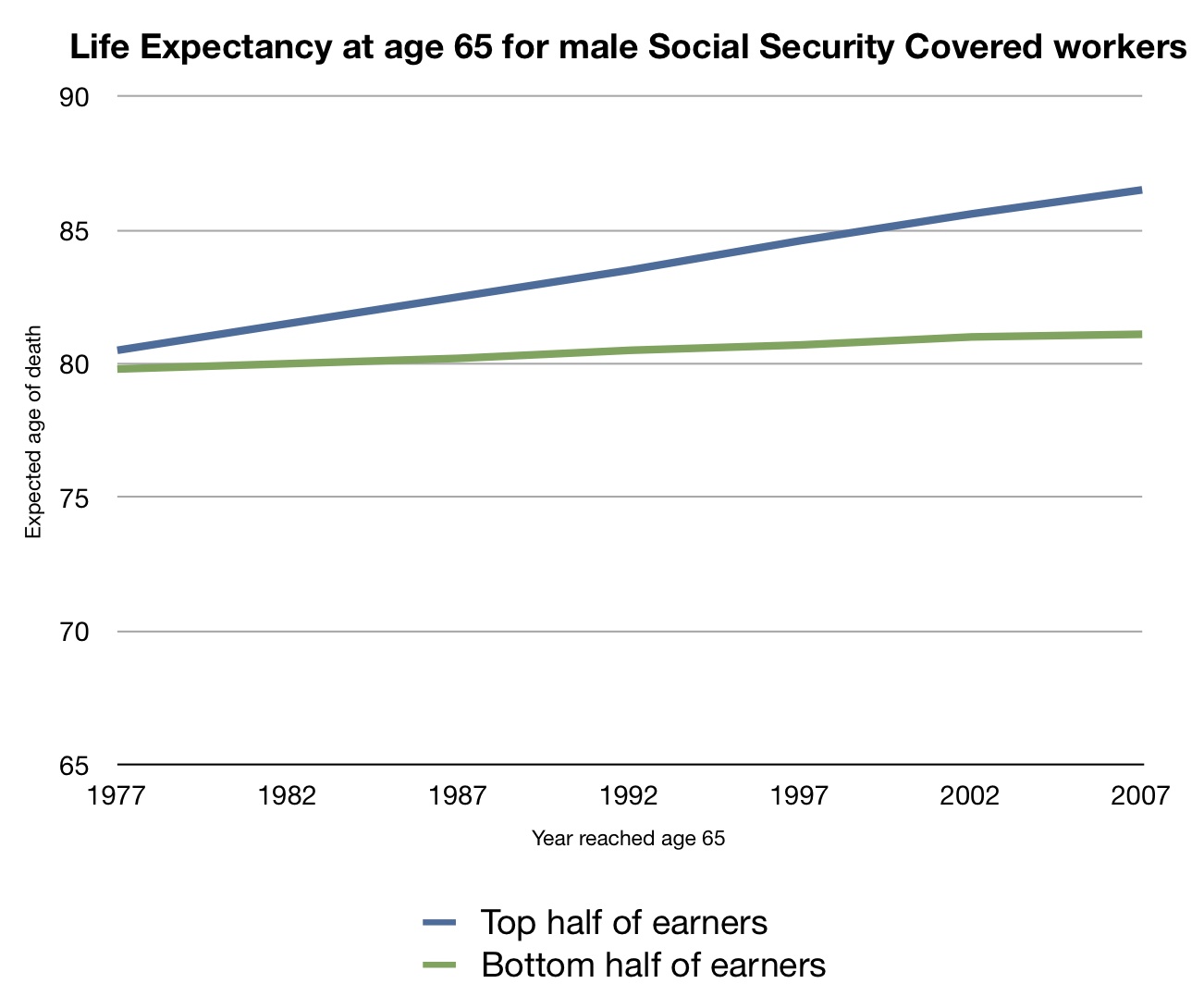
It's worth referring to some of the data that Simpson is aggressively trying to refute. Few would disagree that life expectancy for those people that reach sixty-five has changed in any meaningful way, especially for the poor that actually depend on social security. As Aaron Carroll shows, almost all gains in life expectancy come for those at the upper end of the income spectrum.


It's even more weird to be considering this a major demographic change, or even a demographic problem, because we've known about the baby boomers for an incredibly long time. The HuffPost article points out that Social Security's demographic problems were identified in 1983, and the government was aware of changing demographic trends as far back as 1946. The cost side of changing demographics was fully accounted for in the '83 recommendations of the Greenspan commission.
So to reiterate, no one was surprised by changing demographics, and in fact, nothing about Social Security's "problems" can be attributed to demographic change. Instead, you seem to have a much different and unanticipated problem. Exploding inequality has seriously hurt the amount of revenues that can be generated. Everyone should know that the FICA tax that funds our social programs is capped at 110,000 dollars; i.e. money earned after that point is no longer taxed. This was recently pointed out by the Congressional Budget Office.


As wages have remained stagnant since the beginning of the 1980s, FICA has lost the ability to generate the kinds of revenue that the Greenspan commission anticipated. Simply removing the cap would go a long way towards eliminating the problem. This completely eliminates the need for means testing the program. If you want to reduce the proportional benefits received by the rich, who most would argue don't need social security, just have them pay more into the system.

The current attack on social security really isn't anything new than the greater trend of reduced transfer programs over the last 30 years. Even as income inequality reaches historically unprecedented levels, we have been doing even less to try and counteract it.
Policies that redistribute income have been under attack for a very long time. And there's no surprise where the motivation comes from. I'll let Lee Atwater conclude this little piece,
You start out in 1954 by saying, “Nigger, nigger, nigger.” By 1968 you can’t say “nigger”—that hurts you, backfires. So you say stuff like, uh, forced busing, states’ rights, and all that stuff, and you’re getting so abstract. Now, you’re talking about cutting taxes, and all these things you’re talking about are totally economic things and a byproduct of them is, blacks get hurt worse than whites.… “We want to cut this,” is much more abstract than even the busing thing, uh, and a hell of a lot more abstract than “Nigger, nigger.”

Sunday, November 11, 2012

Just Make It Competitive

Or: the piece in which I try to make an argument in favor of partisanship.

Alternet has a very nice article on liberals' inability to connect with Southern white men. This communication gap is far from inevitable, and its to liberals' own detriment that they cannot find ways to bridge the divide. As Lynn Stuart Parramore writes,
What liberals and progressives don’t seem to understand is that you don’t counter a myth with a pile of facts and statistics. You have to counter it with a more powerful story. And that’s what Obama and the Democrats have repeatedly failed to do. White Southern men want a story that makes them feel proud of America and what it can accomplish. I’m troubled when I hear lefties heap scorn upon the South, partly because I know that the antagonism is precisely what the Mitt Romneys of the world hope for. They want to divide us and keep those regional antagonisms stoked so that the cynical Southern strategy continues to work. Every time a San Franciscan or a New Yorker rails against “rednecks” in the South, he has done Karl Rove’s work for him.

I have argued before that there is an ancient strain of populism in the South – particularly in places like North Carolina – that Democrats could tap into to speak to the white Southern man in terms that might appeal to him. But the truth is, the Democrats have been marinating in their own pro-business snake oil for so long that they have often forgotten what they might have in common with the unemployed mill worker or the Wal-Mart check-out guy. FDR did not make that mistake. He turned on the electricity at my granddaddy’s tobacco farm and I can tell you that the man, as conservative as he may have been, never forgot it. Instead of hating the white Southern man, why can’t Democrats take a little more time to talk about what they actually might do for him?
This should be a powerful argument for most people interested in electoral politics, and it's even more appealing in the abstract (racism is easier dismissed when it's not experienced).  Unfortunately, the standard liberal response to the idea of "reaching out to the south" tends to take on some form of reeducation. "If we can just teach them not to blindly follow [insert hated conservative movement]," they say, "America would be such a better place."

Unfortunately, this line of thinking avoids an important, yet somewhat ticklish, issue: our political system, and the country in general, derives enormous benefit from disagreement. While most of us might find much of conservative thought distasteful, especially the racist, feudalistic sides of it, there's a strong argument out there that says partisanship actually benefits the electorate as a whole.

How? Since, we don't truly have a dominant coalition, our major parties must find ways to attract the interests of various groups. No party will allow itself the become a permanent minority, which provides a large amount of incentive for our politics to evolve. Even under a two-party system, there is probably enough incentive to compete to bring as many different groups into politics as possible. Hence, you all of the sudden have a conservative "wave" over immigration policy and a whole series of thought pieces on how they can better connect with Latinos.

Contrast this to a political system like Italy's, which is so fractured and chaotic that a huge portion of political decision-making becomes about protecting each other and lavishing favor's on each other's constituencies. This can be thought of as a form of cartelization, which works towards reducing competition between different parties in favor of incumbents. While we might often find the competition between our two parties distasteful, there's clearly worse alternatives.

I don't want to blithely conclude that two-party systems are better than multi-party. There doesn't seem to be any evidence either way. More importantly, I think we should be concerned about how our political system encourages large amounts of competition, which has the effect of increasing accountability and expanding political inclusion.

In this sense, a Republican party (regardless of ideology) that caters to only a very small segment of society is a bad idea. I think we should be relieved that there is at least some prominent party members discussing ways of expanding its appeal. "Growing the base" has been one of the best things to have happened to Democrats, regardless of your personal opinion of Robert Rubin.

In the end, we should be hoping for ideas that translate across interest groups (conservative hindus! liberal rednecks!), which would continually open up opportunities for competition and party evolution. This also provides a framework for more Democrat outreach, especially places like the South. North Carolina is considered by most to be a swing state, and it could serve as the launching pad for liberal outreach throughout the region. No coalition is permanent, and Republicans will eventually make inroads with currently "safe" liberal voting blocs like Latinos and African-Americans. Democrats should be planning to do the same.

That also leads to an argument of expanding franchise in the US, but I guess I'll leave for another time.

Everyone Please Support the Rolling Jubilee

This is such an incredible idea. If anyone has a few dollars to spare, please consider this remarkable cause. Not only is it good for indebted Americans, it's great for the country.


You can learn more about the Jubilee here.

Saturday, November 10, 2012

The Persistence of Institutions


After the election, this photo started making the rounds on Facebook. There's an even more detailed version out there as well, but this gets the basic story across.


The map is a great example of "the persistence of social and economic institutions," a term that is commonly found in the work of Acemoglu and Robinson. The most accessible versions of this idea can be found in the books Why Nations Fails or The Economic Origins of Dictatorships and Democracy. Interest readers might also want to check out check out Institutions, Institutional Change and Economic Development by Douglass C. North. Unfortunately, it's hard to find a digital copy of the North book (or any of his books for that matter). It might just want to take a look at Economic Performance through Time, a publicly available article he wrote on the topic.

Anyway, on to institutions. Let's start with a definition, this comes from North:
Institutions are the rules of the game in a society or, more formally, are the humanly devised constraints that shape human interactions. In consequence, they structure incentives in human exchange, whether political, social or economic. Institutional change shapes the way societies evolve through time and hence is the key to understanding historical change.
If institutions are the rules of the game, organizations are the players. While organizations develop and must act within the institutional framework of a society, they also have the potential to shape institutions as well.

We need these two things because the world is a complex place and the challenges we face are larger than what one person can solve. By establishing informal and formal constraints on behavior, institutions give us clear guidelines on how we should act and interact with each other. It doesn't matter too much whether these rules are explicit (in laws) or implicit (in norms), since both guide and direct behavior in ways that is beneficial to us and socially desirable.

Trade is a good example. Many anthropological researchers have found that pre-modern societies often have elaborate rituals in place before beginning any trading session. These are designed to reduce the threat that one side would kill each other. This would be an instance of institutions (here the rules from the ritual) guiding behavior in a collectively beneficial manner.

Although institutions change, they are often very stubborn. This is especially true of extractive economic institutions that are designed to channel the effort of the masses towards the benefit of a limited few. By creating political institutions that are exclusive (and political and economic institutions reflect one other), an elite can use the government along with less explicit forms of power to transfer wealth upwards. These systems tend to persist over time because they give people incentives to stay at the top. Politics may change the elite, but the system rewarding the elite remains essentially unchanged.

Acemoglu and Robinson argue that this is why you see remnants of feudalism is Russia persisting to this very day. This is why Mexico continues to have corrupt elections favoring its elite (something that I remember you posted about recently), and this is why the South continues to favor a distinct set of economic and political policies that favor rich white men over any other group. All of these modern behaviors reflect long-standing institutions that stretch all the way back to their serf-, colonial- and slave-filled pasts.

It's also a good reminder that change, while possible, remains hard. It takes much more than simply changing the politics of today; you must change the institutional framework too. It makes sense why you would be frustrated with "things always staying the same," since the institutions are not shifting much just because we elected some new guy.

Maybe I'm too much of an optimist, but this election is exciting because I see the potential for institutional change. You major social policies about to go into place (Obamacare being number one), along with a significant demographic change and a badly discredited reactionary counter-ideology (the Rove meltdown will be airing in the Quinn residence regularly for the next several years). There's hope that we can now see the kind of generational shifts that can continue to provide more social, political and economic inclusion for many years to come.