Wednesday, February 5, 2014

Almost Everything Jeff Dorfman Says About the Minimum Wage is False

The State of the Union has once again brought up the minimum wage, and the endless debate between economists came back as well. A perfect example this is an article on the minimum wage from Jeff Dorfman, a "professor at the University of Georgia [and] libertarian." Although it should be enough to see the bias from someone who wrote a book against the welfare state publishing an article in Forbes, we can dig into the issue too. For anyone that wants to follow along, here's the OP. It's pretty standard stuff, which makes it a good target.
The Democrats, their union supporters, and liberals in general are making a hard and concerted push for an increase in the minimum wage. President Obama mentioned the subject prominently in his State of the Union address on Tuesday night and even promised to take executive action to increase the minimum wage federal contractors must pay their workers starting in 2015. While Republicans and small business owners are sure to resist this push, it is important that everyone on both sides debates the issue with the correct facts. Much of what you hear about the minimum wage is completely untrue.
Dorfman's article rests on three basic points, we can refute each separately.

1) "First, people should acknowledge that this rather heated policy discussion is over a very small group of people." Statistics don't lie, but you can lie with statistics. Dorfman is inching awfully close to the latter. His definition of low wage people concern only those people making less than 9 dollars an hour. Since most proposals to raise the minimum wage are looking at something from 10-12 dollars an hour, this is a bad arbitrary cut off.

His argument has a lot of this sort of "fuzzy math," which rests mostly upon the reader being lazy or intimidated by numbers. For example, Dorfman writes, "this group of workers is also shrinking. In 1980, 15 percent of hourly workers earned the minimum wage. Today that share is down to only 4.7 percent." This statistic only makes sense if the value of the wage was constant since 1980, which it has not been.


It was closer to 10 dollars back then (in current currency), and a whopping 30 percent of workers earn about that much or less in today's terms (15,000 dollars or less in annual terms). Looking more closely at the data, clearly Dorfman missed something (probably it was intentional). The liberal side of the argument says that the effects occur on a much broader scale. The Brookings Institute (which is itself not all that liberal) estimates that about 35 million workers would benefit from a minimum wage increase. That's about 30 percent of the workforce, and it's not far off from what the SSA says for earners in the economy.

That's a lot of people getting a raise! And a lot of them will be seeing their salaries increase indirectly. They might make slightly about the new minimum wage, but they'll get a raise anyway. The mechanics of this can be technical from an economic perspective, but the behavioral theory on it is quite nice. It comes from anchoring. People often set their wages in relation to a strong data point, and the minimum wage serves that standard. If the minimum wage goes up, there is strong psychological pressure to raise other wages.

2) "I want to bust one more myth about the minimum wage: the relationship over time between the minimum wage and labor productivity." For the most part in this section, Dorfman is right. The $22 minimum wage report that he references is terrible. It benefits his argument to talk about a terrible report, to make "liberals" seem "out of touch."

I don't support a 22 dollar an hour minimum wage for all of the suppply-side problems that Dorfman is concerned about. But that's a lot different that a 12 dollar an hour minimum wage, indexed to inflation (which is as liberal as any Congressional plan on this issue gets). The US already has the third lowest minimum wage, when compared to other OECD countries, so there is little doubt that we could increase it without large negative consequences.

Even more importantly, as Dorfman roughly gets right, total compensation and productivity are not actually all that different in the US. And the "huge gap" that people reference in the productivity numbers definitely does not seem to be an issue until the aughts. There is obviously a concern over the last few years (where we see a gap), but there was a recession.


This descent into a terrible report on productivity masked what is actually a much larger issue. Income going to capital has begun to accelerate away from income going to labor. This, more broadly, is the reflection of a society growing much more unequal. Pay, when it's going out, is going out in the form of stock options to people alreadly vastly wealthier than everyone else.


From Felix Salmon at Reuters.

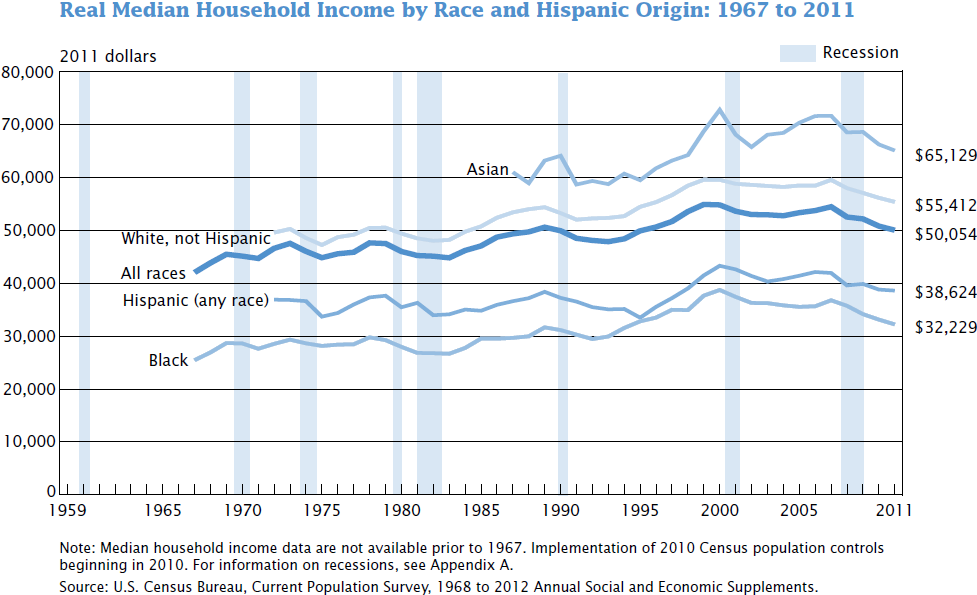
This transformation has everything to do with the fact that median income (moving away from wages) is definitely declining. And that brings us to the most important point of all this.


3) Dorfman adopts a completely hysterical tone, but he nails the debate exactly.
These numbers reveal not just the selective statistics employed by the proponents of raising the minimum wage, but also that the debate has little to do with helping the poor. Instead, this is really a debate about income redistribution. Raising the minimum wage is actually just an attempt by liberals to punish a subset of business owners by redistributing a share of their supposed wealth to their employees. It is just another attempt at class warfare.
This is totally true. The minimum wage does not matter as much for poverty, or employment, as it does for wage distribution and a just society. If you do care about those other two things, you should focus on getting back to full employment first (and the minimum wage doesn't matter as much at full employment anyway). The best thing for a poor person is a job.

Given that caveat, there is still plenty of evidence that minimum wages help reduce poverty (a little), when people have jobs. The EITC, which Dorfman endorses, is a complement to the minimum wage, not a substitute. Both policieis work to increase wages and a balanced approach to poverty reduction should include both.

So why care about the minimum wage? Because, before government efforts, the income distribution in the US and Sweden are basically the same.

And while plenty of loveseat economists love to trot out theories about how minimum wages has a disemployment effect, we should keep two things in mind. Full employment depends mostly on broad monetary and fiscal policy. Getting an ideal level of minimum wages is irrelevant when those two factors are driving up employment. People while hire anyway. The conflicting data on employment effects illustrate this, and regardless of the side you fall on, the effect is modest.

So why care about the minimum wage? Because inequality is almost exclusively an issue of public policy. For many, that might seem strange. The debate on inequality often focuses on "global forces" and "technology," but this is a red herring. You know this as soon as you look abroad. Income inequality in Sweden is almost exactly the same as that of the US, before taxes and transfers.

Take a second to digest that, before policy, the most unequal country in the OECD and the most equal look exactly the same.

High levels of inequality is a problem that economists have been concerned about since Adam Smith. It damages growth, since the rich consume less. It corrupts institutions, since it becomes more beneficial to extract wealth than encourage growth. And it causes social instability. As my dad, a noted philosopher often featured in this space, often says, "you don't see big gaps without big revolutions."

And that, more than anything else, is what Dorfman gets wrong. Acemoglu and Robinson wisely pointed out last year that economists and economic theories often focus too strongly "market efficiency" too the harm of political and institutional well-being. No doubt, there are strong theoretical arguments against raising the minimum wage. The minimum wage is not necessarily the most important anti-poverty program either (FULL EMPLOYMENT!!!). But income distribution is critical to the effective functioning of our society and democracy. Raising the minimum wage and indexing it to inflation is a good place to start solving these problems.

Saturday, January 18, 2014

A Short Note on the Cost Issue

The New York Times has published several incredible reports about the incredibly high costs of health care in the US. Here's Elisabeth Rosenthal:
Doctors’ charges — and the incentives they reflect — are a major factor in the nation’s $2.7 trillion medical bill. Payments to doctors in the United States, who make far more than their counterparts in other developed countries, account for 20 percent of American health care expenses, second only to hospital costs.

Specialists earn an average of two and often four times as much as primary care physicians in the United States, a differential that far surpasses that in all other developed countries, according to Miriam Laugesen, a professor at Columbia University’s Mailman School of Public Health. That earnings gap has deleterious effects: Only an estimated 25 percent of new physicians end up in primary care, at the very time that health policy experts say front-line doctors are badly needed, according to Dr. Christine Sinsky, an Iowa internist who studies physician satisfaction. In fact, many pediatricians and general doctors in private practice say they are struggling to survive.
I won't get too much into the issue right now, but alot of the discussion of cost has made me think about markets. It is not all that different from the way the Stephen Brill (the guy that wrote the incredible Time article that set all of this off) discusses the issue with Jon Stewart.


Health care markets cannot function in the traditional sense because they are based around compulsion. I can't choose to not be treated for cancer. I'd die. This seemingly innocuous flaw leads to all of the insane effects we're seeing now, because there is no mechanism to properly set prices.

Brill's article talks about how an external price mediator must enter. That's politically unpalatable in the US, but it's not impossible. The launch of the Obamacare website shows that when a broad enough spectrum of Americans are affected by a specific problem (not just poor people), government can and often does act quite quickly to solve the issue.

George Will (who is mentioned in the clip) said nothing will be done about prices unless people feel like "they have enough skin in the game." His metaphor was apt, but for all of the wrong reasons. Pricing control mechanism will be introduced after the implementation of Obamacare because all of us will be paying a lot more for each others' insurance. The rent-seeking behavior of hospitals and doctors will not be as possible when it is a problem facing everyone at the same time. With enough political momentum, we'll have results.

Monday, December 9, 2013

Wages May be Declining, but We're Still Better Off Going to College

Nancy Folbre at the New York Times as a great piece on the terrifying stagnation of college graduates' wages. For people who are also consider about higher education's increasing costs, this is obviously bad news. As she writes,
Here’s the good news: Young adults who have finished college continue to earn significantly more than mere high school graduates.

The gap between the median earnings of high school graduates and those with a bachelor’s degree or higher – the red versus the purple lines in the graphs above – remains wide. The difference, over a lifetime, is more than enough to justify the expense of attaining a bachelor’s degree.

Here’s the bad news: Adjusted for inflation, median earnings for young men with a bachelor’s degree or higher in 2011 were significantly lower than they were in 1971. Young women have slightly improved their position (by $630) since 1971. But as a comparison between the two graphs shows, their median is still lower than that of male high school graduates in 1971.
This ultimately is the tale of two charts, and the decline in wages experienced by men is especially dramatic.


Much recent debate over the causes of economic inequality has focused on the extent to which technological change (robots in particular) can take the blame. But whatever the causes, the political consequences of a continuing decline in the real average wages of young college-educated workers will be momentous. It will undermine faith that a market economy always rewards effort, intelligence and skill, increasing awareness that most working people, not just those who didn’t go to college, are vulnerable to impersonal forces of supply and demand.

 The causes and effects of this massive change leave a lot to unpack.

Are decreasing earnings for college graduates the effect of increasing supply? Is the market being flodded?

There is no doubt that the percentage of people attending college is now higher than it was in the 70s. But surprisingly it isn't much higher than you'd expect. From '71-79 (for men 25-34) college completion rates jumped from 20 to about 27.5 percent. For the next 10 years it actually declined, and it only recently exceeded that '79 peak. That said, it is still under 30 percent. Which, in terms of flooding the market, is pretty small.


On the other hand, college attainment for women has steadily risen over the whole period. It exceeds the attainment rate of men by quite a bit. This corresponds to the increase in women's median wages over that period. That said, college-educated women now still earn less than high-school age men in 1971. So, this isn't exactly some huge feminist victory.

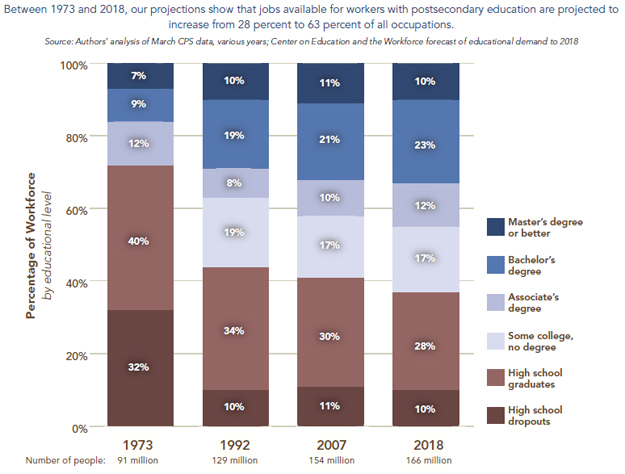
To "flood the market," you need supply to exceed demand. The exact opposite is happening. The US has a shortage in highly skilled workers for certain professions, and the need for people with bacherlor's/ higher degrees is only going to increase in the future. While the demand for people with lower education has been steadily eroding for decades. Thank computers/robots/globalization for all of that. 


Addressing that problem would mean increasing the supply of college educated workers. To do that, two things need to happen: the cost of college needs to decrease, while the expected earning from a college degree needs to increase. In other words, college needs to become a better deal for more people to go. The opposite is happening, which is creating this nasty problem in US labor markets. We have a shortage in the kind of workers we need, while we have a surplus in the kind we don't need.

This is a classic example of the problem of externalities. The benefits we get from education far exceed the market price. For that reason, government is expected to subsidize the product so that its social cost and social price are equal. The library of economics and liberty explains this well.

Externalities are probably the argument for government intervention that economists most respect. Externalities are frequently used to justify the government’s ownership of industries with positive externalities and prohibition of products with negative externalities. Economically speaking, however, this is overkill. If laissez-faire—that is, no government intervention—provides too little education, the straightforward solution is some form of subsidy to schooling, not government production of education. Similarly, if laissez-faire provides too much cocaine, a measured response is to tax it, not ban it completely.
This is not happening in the US right now. Most public education is funded at the state level, and the states have been cutting back. The result is far less college graduates than we actually need, while we have a surplus of lower-skilled workers.


Does your major matter? Isn't this the fault of (insert literature, philosophy, theater or whatever other liberal humanity you wish to disparage) majors?

Yes there are a diversity of earning potentials for college degrees. The Wall Street Journal does a good catalog here. But even though things like Spanish pay a lot less than things like computer science, it's a big mistake to think that Spanish is "worthless." The starting median salary for basically all degrees is higher than the mid-career median salary for people without degrees. That gap will persist throughout people's careers, irrespective of the degree they got.

This goes back to the NyTimes article and something I mentioned above. The demand for people without college education is declining at a steady clip, but the supply of these types of workers is essentially constant. You see the standard economic result: wages for these types of jobs are catastrophically collapsing. The median wage of a high-school educated man in 2011 in FORTY PERCENT LOWER than that of a man in 1971. Take a second to process that. The punishment of not attending college now is a wage that is half of what you would expect 40 years ago. Ouch.


Well if that's the case, why the hell should I deal with the misery and cost of a college education? Why don't we all go the Peter Thiel route and become entrepreneurs?

In general, it is terrible advice to tell someone to not going to college these days. Outside of a few key trades (which have their own education/ apprenticeship system), you are essentially condemning them to a life just above the poverty line (and not much better for plumbers and other skilled craftsmen; certainly worse than college grads). On the upswing, no matter what you study, even if it isn't all the way to completing the degree, your earning potential after college will be quite a bit higher (big caveat: just don't bury yourself in debt).

Now, despite all my liberal inclinations, poverty in the US is not so bad (certainly better than in the 70s when the war on poverty began), and it is actually getting better. But this has everything to do with the those entitlements that the right despises. Without significant redistribution of money to the poor, things would be pretty bleak (even bleaker than this). In other words, because of pressures in the labor market, we are essentially forced to implement a form of light socialism in order to make life in America bearable. Think about Walmart and McDonalds workers on food stamps. There's a lot of them, and they typify America's low wage problem.

From the Atlantic Cities Blog.
The conclusion of basically all studies on this topic is that it is still essential for kids to attend college, and it is still worthwhile despite a lower education premium and higher costs (if only because the alternative is pretty horrific).
 

That's all great. I'll send my kids to college. Considering where we started in the beginning, what have we learned today? 

It's quite exciting to know how much we can glean from what is a relatively simple statistic. But here's some bullet points:
  • We need to increase college graduation rates in America.
  • To do that we need more kids going to college (which depends almost exclusively on getting kids out of poverty).
  • We need to make college less expensive (which is related to public funding) 
  • We need to increase the amount of money earned for a college degree 
  • Ideally, growth in wages should track with growth in GDP/ productivity (this stopped about 20 years ago, once income inequality started becoming a real problem).
The policy implications aren't all that simple, and they certainly aren't all that pleasant for people who prefer laissez faire (like Ryan Avent over at The Economist). We've seen inequality surge as transfers from the rich have decreased. The only way you're going to fix this is by taking all of that income growth going to the rich and handing out to the (potential) middle class as a set of services (health care, education, preschool) or actual money (tax credits).

Your other alternative is giving low-wage workers the ability to negotiate higher pay (through unions) or mandating higher pay (through national wage standards). Ultimately, though, both of these are redistributive policies (which is why conservatives aren't very fond of them).

This gets us stuck in the wage problem that started this whole conversation. Even if you don't want to create policies for redistribution to the middle class (or redistribution to expand the middle-class), you're stuck with redistribution to mitigate the problems for the expanding poor. For Republicans, you'll need to redistribute to middle class now or redistribute to the lower class once the middle class fully collapses. It's a really shitty choice. I apologize.

Subsidizing the middle class might not be the worst thing to have ever happened. Thomas Friedman isn't exactly Lenin, but he sees a strong incentive for some form of universal economic baseline, one that encourages people to aspire for more. You give everyone a social bottom line, and you expect them to compete from there. This still allows for inequality, but it is more fair in the sense that everyone at least gets to keep by essentially the same rules.

There is an economic concern here too, if we ultimately decide to not subsidize the middle class (through redistribution, wage hikes, unions or all of the above). Is this weird labor market dynamic good for long-term growth? Probably not. Is it good for society and political outcomes? Definitely not. There are more than a few "people's revolutions" that attest to that.

Thursday, November 7, 2013

Do we need a new theory?

Students at the University of Manchester have a sharp critique for the current economics curriculum, and they believe that the neoclassical school of thought is seriously deficient. As they write in The Guardian,
The Post-Crash Economics Society is a group of economics students at the University of Manchester who believe that neoclassical economic theory should no longer have a monopoly within our economics courses. Societies at Cambridge, UCL and LSE have been founded to highlight similar issues and we hope this will spread to other universities too. At the moment an undergraduate, graduate or even a professional economist could easily go through their career without knowing anything substantive about other schools of thought, such as post-Keynesian, Austrian, institutional, Marxist, evolutionary, ecological or feminist economics. Such schools of thought are simply considered inferior or irrelevant for economic "science".

We are taught to memorise and regurgitate neoclassical economic theories and models. Our tutorials consist of copying problem sets off the board and critical discussion is non-existent. We studied our modules and found out that only 11 out of 48 even mentioned the words "critical", "evaluate" or "compare" in their course guides. Eighteen out of 50 of our modules have 50% or more of their marks awarded by multiple-choice exam and in nine of these it is more than 90%. This, combined with the fact that economics students don't have the option to do a dissertation, means that many accept economics as truth, rather than as contested theory.
Their article brings up a couple of issues. The first concerns the definition of "neoclassical" economics, and its conflation with mainstream economics. As Noah Smith explains, a common lazy critique of mainstream economics is to call it "neoclassical," without offering a particularly rigorous definition of the term. The UM students fall into this trap, since their entire mainstream curriculum is brusquely written off as "neoclassical." While the term can roughly cover economics that focus on "[a]ssumption of individual rationality, utility maximization, and supply/demand", a lot of actual economics doesn't cover focus on this. As Noah explains,

But does it describe most of maintstream economics research? Theory papers have declined from over half of top-journal econ papers in 1963 to less than 28% in 2011. Empirical papers make up most of the rest, with experimental economics growing to just over 8%.

How many of those empirical papers should be described as "neoclassical"? Some of them, no doubt. Some of them explicitly include neoclassical models; others test neoclassical theories developed in other papers. But many mainstream empirical papers contain no reference whatsoever to individual rationality, utility maximization, and supply/demand.

For example, take this famous paper by Acemoglu, Johnson, and Robinson, entitled "The Colonial Origins of Comparative Development: An Empirical Investigation" (American Economic Review, 2001). This paper measures the effect of institutions on growth. It does not make use of a neoclassical model. It does not test a neoclassical model. It does not include any assumption of rationality (or indeed, any model of individual behavior at all!). It does not include utility or supply/demand.

For an example from experimental econ, take "Bubbles and Experience: An Experiment", by Dufwenberg, Lindqvist, and Moore (American Economic Review, 2005). This experiment establishes conditions under which financial markets in a laboratory will result in asset price bubbles and crashes. No assumption of rationality is made, no model is referenced or tested, and no ideas of supply/demand or utility make an appearance.

These are mainstream papers, published in the most mainstream of econ journals. And there are many others like them. Does their very mainstream-ness automatically make them "neoclassical", even though they have zero of the elements that are commonly held to define neoclassical economics? If so, then I contend that the word "neoclassical" has lost all useful meaning.

"Neoclassical" should not be synonymous with "mainstream". "Neoclassical" should be used to describe a certain set of economic methods and/or ideas. Instead, "neoclassical" seems often to be used to describe anything that does not fall within a small well-known set of "heterodox" paradigms. I think that is wrong. The net effect of that type of thinking will be to block people from thinking of new ideas, because it defines any really new approach as "neoclassical". So people who want to subvert or replace econ's dominant paradigm will be shepherded toward old alternatives such as Austrianism, Post-Keynesianism, etc.
This gets to the real heart of the problem with the students' assessment of their curriculum. I think there is a lot of worthwhile ground for addressing the problems of equilibrium and instrumentalism in modeling, but I'm just not a good enough econometrician or too invested in any school of theory to try and pick that fight. I'll let Christian Arnsperger and Yanis Varoufakis do that sort of work.

A more important issue is at stake. As the New Yorker explains, there have been major institutional changes in how science sees itself over the last decade. Reproducibility, transparency and shared data are quickly becoming fundamental aspects of scientific publication, and it should go a long way towards cleaning up science's biggest biases (like publication bias and researchers' unwillingness to publish negative results). Economics pedagogy needs a similar housecleaning. It needs to become closer to modern economics research and practice.

By and large, I don't think the problem with economics is one of theory, regardless of whether this theory adheres to a particular school. More broadly, the biggest problem in economics is empirical. All branches of economics have too much theory that is entirely untested (labor economics is one of my favorite punching bags). Some of this comes from economics' "creep" into other social sciences (like the Freakonomics problem), but the bulk of the problem comes from economics' tradition as a moral philosophy, a method of historical explanation and a tool of political ideology. As Krugman is wont to say, you can find an economist to support any political platform. This is obviously a problem.

Predicting crises may not be a good metric for assessing the quality of a specific economic institution, but it can be a good measure for charlatanism. The most recent economic crisis has shown that economics, as it is practiced in America's premiere institutions, is in pretty good shape. The Fed may not have been far ahead in its predictions of economic disaster, but its response proven to be very effective, miles ahead of the bank's response to previous crises (and that of other central banks, like in Europe). The current economic problems facing the US have a lot more to do with political institutions than economic ones, and economics is not able to solve political problems (nor should it).

The students at Manchester should be welcome to criticize the school of theory they're forced to learn, but I'm much more concerned about their ability to acquire the tools to assess the accuracy of the all theories they're interested in. Theory has a bad habit of providing a false sense of veracity, and developing a skeptical, empirically-driven mindset takes a lot of hard work. We're fortunate to have the tools to make this attitude widespread in the discipline, but this requires teaching the computer science and statistics skills that remain absent in most economics programs. An economics student who can data munge will ultimately be much more beneficial to society than one that can recite all of the assumptions of the ISLM model, and I'm looking forward to students writing The Guardian to ask for that.

Wednesday, October 16, 2013

The EMH and Me

Following the 2008 financial crisis, a small cottage industry emerged to critique some of the economic theories that were somehow accountable for the institutional problems America faced. One of the most prime targets was the Efficient Markets Hypothesis, a theory that has been used to both justify and condemn just about every possible financial activity.

I think a lot of us here would argue against the strong ideological implications of the efficient market hypothesis, at least until our libertarian friends start spamming the comments. But the political aspects of the EMH do an incredible disservice to the empirical reality that Eugene Fama described: it is practically (but not entirely) impossible for investors to regularly outperform the market.

This simple but powerful idea drove the formation of an entire industry's worth of index funds, which remain, by far, the best possible investment vehicle for individuals.

Congrats on your Nobel Dr. Fama. It is well deserved.

Cochrane sums it all up beautifully:
Gene’s ideas are alive, and his contributions define our central understanding of financial markets today. His characterizations of time varying bond, stock, and commodity returns, and the three-factor model capturing value and size effects remain the baseline for work today. His characterization of predictable foreign exchange returns from the early 1980s is still one of the 2 or 3 puzzles that define international finance research. The critics still spend their time attacking Gene Fama. For example, researchers in the “behavioral finance” tradition are using evidence from psychology to give some testable content to an alternative to Gene’s efficient market ideas, to rebut caustic comments like mine above about “fads.” This is remarkable vitality. Few other idea from the early 1970s, including ideas that won well-deserved Nobel prizes, remains an area of active research (including criticism) today.

Of course, some will say that the latest crash "proves" markets aren't "efficient." This attitude only expresses ignorance. Once you understand the definition of efficiency and the nature of its tests, as made clear by Gene 40 years ago, you see that the latest crash no more "proves" lack of efficiency than did the crash of 1987, the great slide of 1974, the crash of 1929, the panic of 1907, or the Dutch Tulip crisis. Gene's work, and that of all of us in academic finance, is about serious quantiative scientific testing of explicit economic models, not armchair debates over anecdotes. The heart of efficient markets is the statement that you cannot earn outsize returns without taking on “systematic” risk. Given the large average returns of the stock market, it would be inefficient if it did not crash occasionally.

Gene’s work has had profound influence on the financial markets in which we all participate.

For example, In the 1960s, passively managed mutual funds and index funds were unknown. It was taken for granted that active management (constant buying and selling, identifying "good stocks" and dumping "bad stocks") was vital for any sensible investor. Now all of us can invest in passive, low cost index funds, gaining the benefits of wide diversification only available in the past to the super rich (and the few super-wise among those). In turn, these vehicles have spurred the large increase in stock market participation of the last 20 years, opening up huge funds for investment and growth. Even proposals to open social security systems to stock market investment depend crucially on the development of passive investing. The recognition that markets are largely “efficient,” in Gene’s precise sense, was crucial to this transformation.

Unhappy investors who lost a lot of money to hedge funds, dot-coms, bank stocks, or mortgage-backed securities can console themselves that they should have listened to Gene Fama, who all along championed the empirical evidence – not the “theory” – that markets are remarkably efficient, so they might as well have held a diversified index.

Thursday, October 10, 2013

Ron Paul's Unusual Proposition

Ladies and gents, Dean Baker endorses a Ron Paul policy idea. No matter the subject, that's always worth sharing. As Baker writes over in The New Republic,
In short, Representative Paul has produced a very creative plan that has two enormously helpful outcomes. The first one is that the destruction of the Fed’s $1.6 trillion in bond holdings immediately gives us plenty of borrowing capacity under the current debt ceiling. The second benefit is that it will substantially reduce the government’s interest burden over the coming decades. This is a proposal that deserves serious consideration, even from people who may not like its source.
I'm no expert on monetary policy, but there's some interesting debt ceiling theory crafting here. Granted, just like all of the other fantasy intervention scenarios, all of this comes with a giant caveat: we have to assume that the need for an intervention won't spur some form of market panic. We've seen a few times already how these can become catastrophically self-sustaining. Once that threshold is crossed, it doesn't matter what the Fed does.

But let's just assume that won't happen for a moment. Instead, we'll pretend that the Fed has announced with sufficient time before the debt ceiling deadline that it intends to intervene in order to ensure stability in the global financial system. This is totally within their mandate, so people wouldn't be that surprised if the Fed chose to do this. But, surprisingly, they'll announce that they plan on executing the "Ron Paul Plan."

Paul's idea, as Baker happily points out, rests on one of the great paradoxes of modern finance. The Fed is largest buyer of treasuries and by far the largest holder of US debt. All of the principal and interest that the Fed earns is eventually returned to the government. It's weird to think about, but the Fed is actually a profit center. In 2012, it sent 77 billion dollars back to the treasury.

It is totally within reason for the Fed to notify the government that it no longer intends to collect on its bonds. Or, as Ron Paul dramatically puts it, the Fed could "destroy" the bonds that it holds. Either way, this would allow the administration to issue new debt, since the debt ceiling is set at a specific dollar amount. The Fed holds about a trillion dollars in different government securities right now. Cancelling this debt would solve the debt ceiling problem for about a year.

It's an especially nice solution since there is no legal gray area. A bondholder is not legally obligated to collect his or her debt. We never have to deal with this under normal circumstances since everyone does want their money (why else would you buy a bond?). That doesn't change the fact that it is totally possible to just walk away. If the Fed walks away, the government gets a whole new chance to borrow again. Think of it like some giant bureaucratic jubilee.

So what are the consequences? As Baker points out, the Fed uses its treasuries as the key tool in balancing the availability of money and the ability of banks to lend. This is all a part of short-term interest rate targeting. If the Fed wants to reduce the aggregate amount of lending, it sells its treasuries to banks. The banks pay for these treasuries out of their reserves, and the banking system now has less money available to lend.

By bringing up this issue, Baker is taking into account a risk that is normally top priority on the right. All of the Fed's efforts over the last five years have greatly expanded the monetary base, creating the potential for inflation. The Fed's huge reserve of treasuries are insurance against this risk. If the economy grows stronger, and if inflation starts to creep upwards, all the Fed needs to do is sell off some of its bonds, reduce the money supply and cool things down a little.

Baker isn't in the tinfoil hat group that believes we are waiting for hyperinflation. That's normally Ron Paul's gig. Everyone else recognizes that we have far too low of growth to even experience normal inflation right now. This is why the Fed continues to engage in Quantitative Easing, which is nothing more than the Fed buying up all sorts of securities from banks so that they have more money to lend. But that doesn't change the fact that the Fed needs to be on guard against potential inflation in the future, and it needs tools to deal with it.

Without its treasuries, the Fed obviously can play the same game anymore. If inflation were to rise, it would need something to sell in order to reduce the monetary supply. Destroying the bonds that it holds severely reduces its stock of available assets, and it also gets rid of the most typical and liquid asset that the Fed owns. But that doesn't mean that the Fed would be totally helpless.

The Fed has another tool to manage the overall amount of money lent that it tends not to use all that often. As you know, banks are required to hold a certain amount of money in reserve as backstop for all of their outstanding loans. This reserve amount is set by the Fed, and they are the only governing body that has a say in the matter. If it wanted to, the Fed could go out there today and tell banks that they need to hold greater reserves. Banks would have to call in some outstanding loans to meet the new, higher reserve requirement, and this would ultimately have the exact same effect as the Fed selling its Treasuries.

Again, assuming no market panic, this is a totally viable scenario. Despite its source, it actually makes a whole lot more sense and poses way less risk than many of the other schemes proposed. If the Fed destroys its bonds, no other bondholder is affected. They can all collect as before and the "dollar hegemony" can keep on trucking to the next crisis. There wouldn't be a freeze up in lending, nor would the Fed remain powerless to prevent future inflation. The biggest problem I see is that this is kind of a one-off. The Fed wouldn't be able to build up its bond portfolio quickly enough to pull the same stunt again.

There's obviously a legitimacy problem too. What happens the next time Congress refuses to raise the debt ceiling? Unfortunately, very few of possible workarounds solve this problem directly. For that reason, this is all a bit of fantasy. That doesn't mean that it isn't fun.

I hear Congress is trying to offer at least a short-term raise. It should give us about six weeks to come up with other platinum coin kinds of ideas. I don't mind. It's much better than contemplating the apocalypse, that's for sure. Until next time.

Wednesday, October 2, 2013

Game Theory for Government Shutdowns

While there are many ways to try and understand the government shutdown, I like to take a game theory perspective. By focusing on incentives, it helps clarify each side's behavior, and it helps paint a road map for the next couple of weeks. Even if it's all pure speculation, and there's a nearly 100 percent guarantee that things will turn out differently, it's still intellectually stimulating. So let's give it a go!

I'll start with Chait's description:
Obama’s incentive structure is simple, then: Allowing Republicans to default on the debt now is better than trading something that allows them to threaten it later. His best option is to refuse to negotiate the debt ceiling and have the House raise it before October 17. His next best option is to refuse to negotiate the debt ceiling, allow default, and never have to go through it again. Bargaining merely postpones, and worsens, the next default crisis. No negotiated debt-ceiling price is small enough to be acceptable. There is therefore no circumstance under which bargaining for a debt-ceiling hike makes sense, even if the alternative is certain default.
 I think he's wrong on one point. Obama's second best option, before default, is the Constitutional problems created by his unilateral intervention. Raising the debt limit on its own (or just abolishing it), invites a continued fight with Congress, but it avoids economic harm. He's stuck with a shut-down government anyway, a continued political crisis is essentially the same thing.

One of the biggest mistakes of most observers on the left is to label the behavior of Republicans in Congress as crazy. This isn't just offensively dismissive, it does the observer a huge disservice by ignoring the other side's incentive structure. In fact, as Justin Fox writes over at HBR, the incentive structure for Republicans is very clear and very easy to decipher. Especially since it's completely rational!
Let’s consider what House Republicans have learned from their two years of debt-limit brinkmanship. They have learned, first of all, that it works. They got the White House to agree to a bunch of automatic spending cuts (the sequester) in 2011, and then in early 2013 they were able, from what seemed to be an exceptionally weak bargaining position after President Obama’s reelection, to keep most of the Bush-era tax cuts from expiring and to force yet another debt-ceiling battle only a few months later. More broadly, Republican office-holders and activists have learned over the past couple of decades that making what at first sound like unreasonable demands (no new taxes, no gun control) and repeating them for years on end can actually shift the terms of the debate to the point where the demands seem normal. It has been a successful strategy.

There have been downsides to the GOP’s debt-ceiling brinkmanship. It was a drag on economic growth, for one thing, but that’s pretty distant and diffuse and hard to prove. More tangibly, it also probably played a role in the Republicans losing six seats in the House and failing to unseat President Obama in the 2012 election.

From the perspective of the 30-odd hardline members of the House GOP that for the sake of convenience I’ll call the Tea Party, though, this wasn’t actually bad news. Their districts tend to be pretty safely Republican, so their jobs aren’t at risk. A smaller Republican majority in the House increases their leverage within the caucus. And in part because Republicans controlled the redistricting process in most states after the 2010 census (a byproduct of the anti-Democrat backlash in the 2010 elections), they don’t have to worry much about the GOP losing its House majority soon. As for Obama’s victory over a Republican nominee the Tea Party never fully embraced, that wasn’t the worst thing in the world either — it certainly helps with fundraising and energizing the base. So while it has become popular to label the Congressional Tea Partiers, and their seemingly increased zeal after a lost election, as “crazy,” most of their behavior can be pretty readily explained by self-interest and learning from recent experience.
Going into the shutdown, the Republicans now have an even smaller incentive to reach a decision before the debt limit than before. Paul Ryan stated this pretty clearly awhile back. We're guaranteed to see no resolution before then. If we do, they're basically guaranteed to face backlash for creating a crazy mess for no reason. They're probably better off digging in.

Moreover, they too have very little pressure to compromise as long as the Hastert rule is maintained, since electoral consequences are small. This leads to some fun possible scenarios. Even the most extreme options aren't totally off the table.

Since Republicans don't think the President will let the country default, they'll intentionally skip the debt ceiling deadline. We'll get a unilateral debt ceiling increase and Republicans will get the opportunity to impeach Obama. This is something they've always wanted, and it fulfills the underlying motivation for this mess. They believe Obama's presidency is illegitimate, and now they get to show it. The Senate will acquit, and maybe then, and only then will we see sides back down. But that basically guarantees a shuttered government for something like a month, and it firmly establishes the precedent for more insane behavior in the future. Fun times.

Obviously, this is one of just many options. And this sort of events would seem totally insane for most people around the world. And yet, both sides would still be operating in a rational way that maximizes a sense of well-being over a certain times. Uncrazy behavior, under unusual incentive structures, often has some really crazy consequences.